I’ve began working on a professional certificate offered by Google through Coursera. So far, I enjoy the structure of the courses and know that I’d be heavily interested in pursuing UX design as a career.
I like the ability of combining my technical abilities with my creative abilities. I also feel that the qualities I’ve inherited from past work experiences have allowed me to embrace empathy and intuition which I feel would be strong suits as I take on this journey.
I hope that the certificate allows me to build a respectable enough portfolio so that I can start applying to entry level roles as a UX Designer. I’d be interested in finding apprenticeships or full time roles so that I can become an expert in this field.
Various forms of data repositories have their pros and cons but are also used for varying purposes depending on the insight we wish to obtain.
One main form is simply a database which is used to collect data for input, storage, search, retrieval, and modification of data. There are two main types which include Relational and Non-relational databases. A relational database uses the format of rows and columns and is queried by the used of SQL. While a non-relational database is widely used for processing big data and is designed to be used with NoSQL (Not only SQL).
A data warehouse is another form of a data repository which is used to work as a central repository merging information coming from different sources.
Finally there are also Data Stores which are used for very large sets of data.
The raw data we pull from various formats could come in different forms such as by being Structured, semi-structured, and unstructured.
This raw data is then pushed towards various data repositories such as databases, data warehouses, data marts, data lakes, and big data stores.
Various languages are used to organize, maintain, transform, and interpret the data such as query languages (i.e. SQL), programming languages (i.e. Python), and shell/scripting languages.
A modern data ecosystem includes interconnected, independent and continually evolving entities. Various forms of raw data are pulled from their original sources into a data repository which make up part of this ecosystem.
Our role as data analysts include being able to find patterns/correlations within the data to provide insight to end users such as the stakeholders. We can say that there are 4 types of data analysis which are Descriptive Analytics (“What Happened”), Diagnostic (“Why?”), Predictive (“What will happen next”), and Prescriptive (“What should be done about it”).
This is by far the longest I have gone without blogging. As of December 2020, I have been a college graduate with a degree in Economics and minor in Philosophy! I am proud of what I have accomplished and so decided to give myself a break from both school and work to treat myself for the hard work.
I have done a bit of traveling and have gained insight into what actually interests me. However, my passion for tech has not died down in the slightest. This year I will move to Houston and start a new life there so that I can be closer to my extended family.
It’s been a while but I’ve decided to go ahead and brush up on my Data Structures & Algorithms every week as a way to strengthen my problem-solving skills. I’m a strong believer in the concept of compound “learning,” so I’m hoping to see results in the near future. This week I began my review of Recursion which a truly fascinating concept.
Learning things visually is pretty much the best way for me to retain any kind of information so I found it helpful that a TA from a couple semesters back would attempt to help us visualize how it is that recursion works. She plainly stated that it can be thought of as a “grapevine” situation where a person at the front of a line decides to share a thought or an idea which is then passed on until it reaches the end of the line, then back again to the person who stated it at the very beginning.
In a programming environment, we must be careful not to cause a “stack overflow” situation where in which we are unaware of what the base case actually needs to be in order for the recursive function to actually stop. The “return” function is also greatly relevant in helping the function read the end of the recursion.
Primarily, any time we are forced to work with trees or graphs (i.e. traversing a file system) recursion may be the cleanest method in helping us solve the given problem. However, we should not forget that any problem that can be solved iteratively, can also be solved recursively and like any piece of knowledge in the computer science world—it should not be abused. Therefore, if the iterative solution is a lot more helpful (for instance, if we are worried about memory allocation), then we should be careful not to force a recursive solution.
This is not a post about tech but I’ve lacked on my ability to stay consistent because of the excuses I’ve given myself. Here is an update: I’m now approaching my tenth week or so of my final semester as an undergrad and have been working a job at a bank since the beginning of the summer so I have unfortunately not been able to focus on what I view as my career.
At the time of accepting the job it seemed like a good opportunity by means of financially being able to support my desire to buy more books and courses on all things tech. Not only this but I planned to also work there until I was able to get my first job as a web developer. However, last week I decided to quit. It’s mentally taxing working at a call center and I simply took note of my low grades as an indicator that I should no longer carry on that much weight—especially if I do not enjoy myself.
I once promised myself that I wouldn’t make any personal decisions based on money and had realized my job’s money was wholeheartedly the only thing holding me there. And while I do have immense respect for the many great people that do work there for a living I cannot any longer.
My grades have taken a toll and my biggest aspiration has been neglected. And while money is good to support myself I find little to no point in beating around the bush to achieve what I would really like. I’d like to graduate college and become an engineer and while I plan to be unemployed until I reach that goal, I can happily say that this a much better reference point than before.
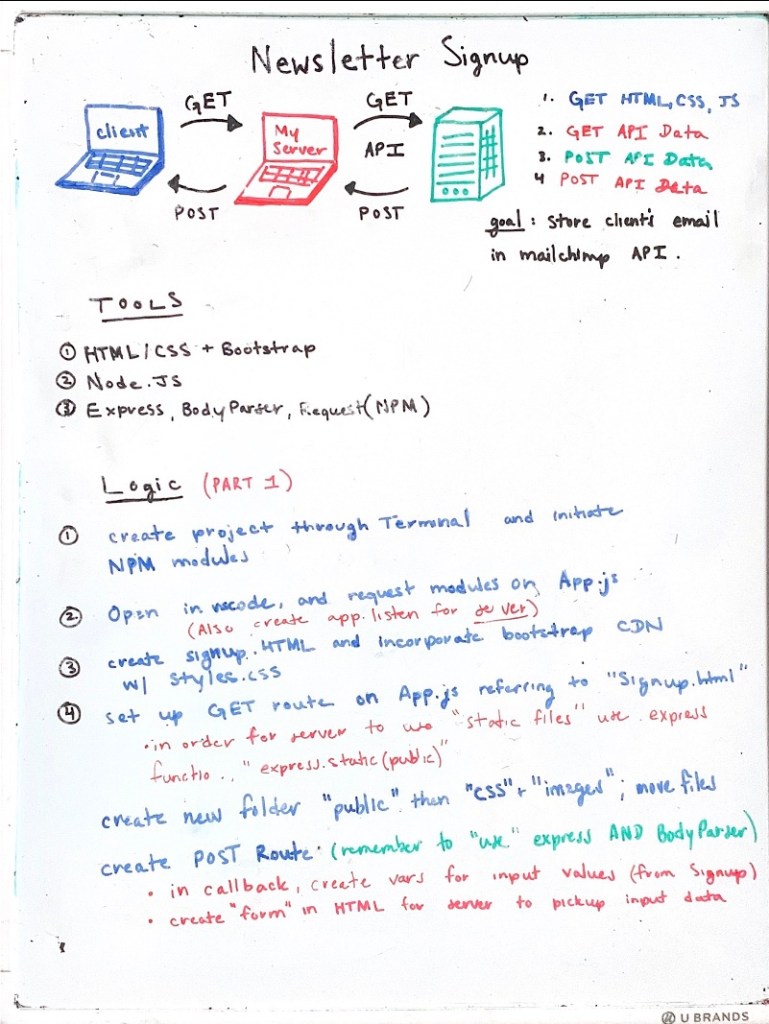
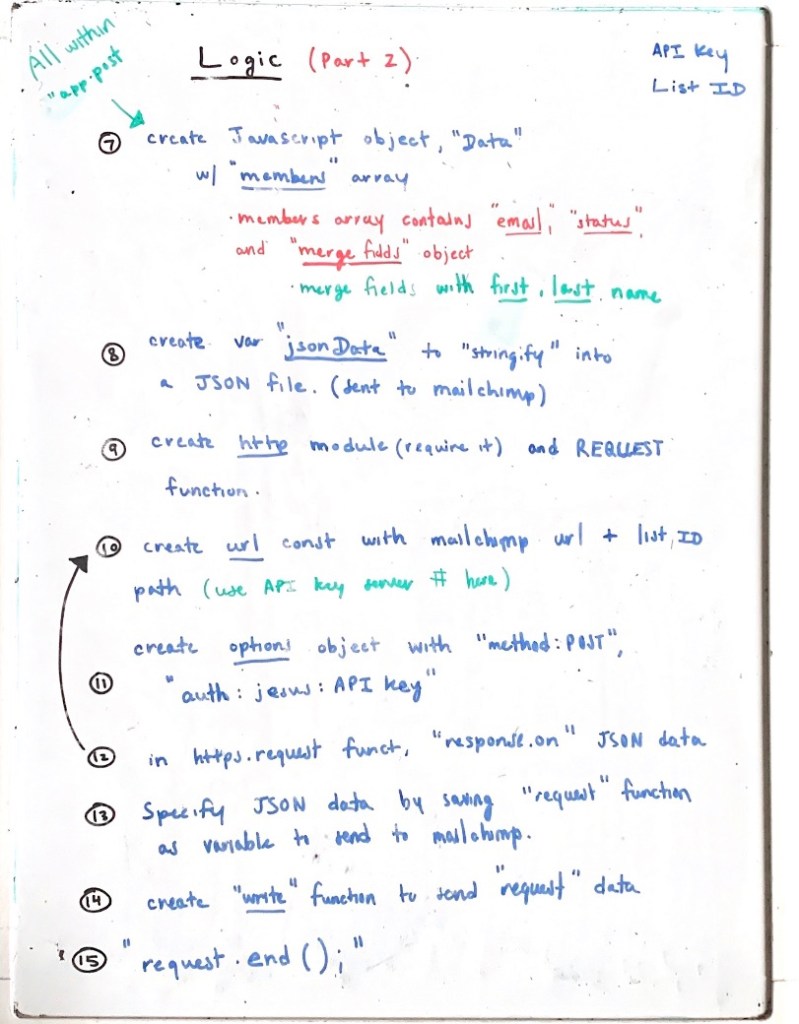
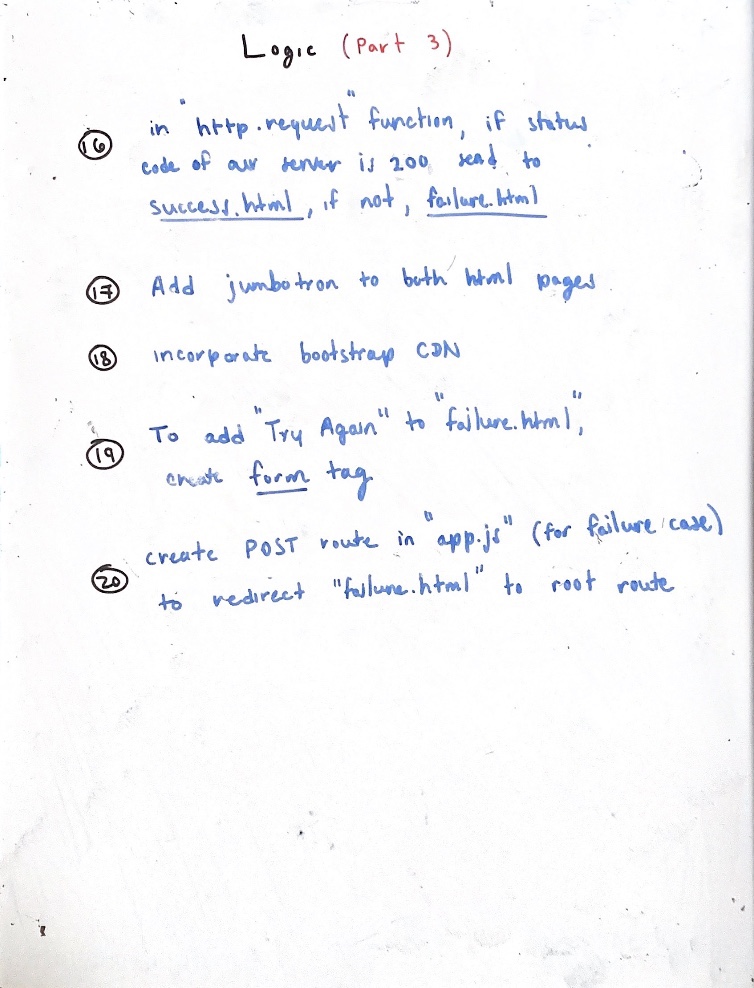
Lately, I’ve been able to work on a small project that culminates many of the tools and frameworks I’ve gotten to learn about. It’s a simple Newsletter Signup page but it does the job well. Essentially, the webpage would first allow clients to access it through their server where in which they would simply write their name and email so that I could store that information through my server as a POST request to the mailchimp API server. I divided the project into three parts and used a variety of tools to code and deploy (it’s not mentioned but I used Heroku) this simple Signup page. I’ve decided to add additional images of the logic I implemented for those who wish to go into more detail.
I first decided to create a server so clients can communicate with the sign up page.
Then, I had to incorporate the mail chimp server via their api to save the user’s data.
Finally, I simply added success and failure pages to let the client know whether they’ve signed up or not via a status code that’s read by the server.
My process is far from over and recently, I’ve gotten the opportunity to learn more about what the back-end entails in terms of web development. I’ve learned how to use Node.js to create my first web server and even got some hands-on practice using the Express framework to get me started as well.
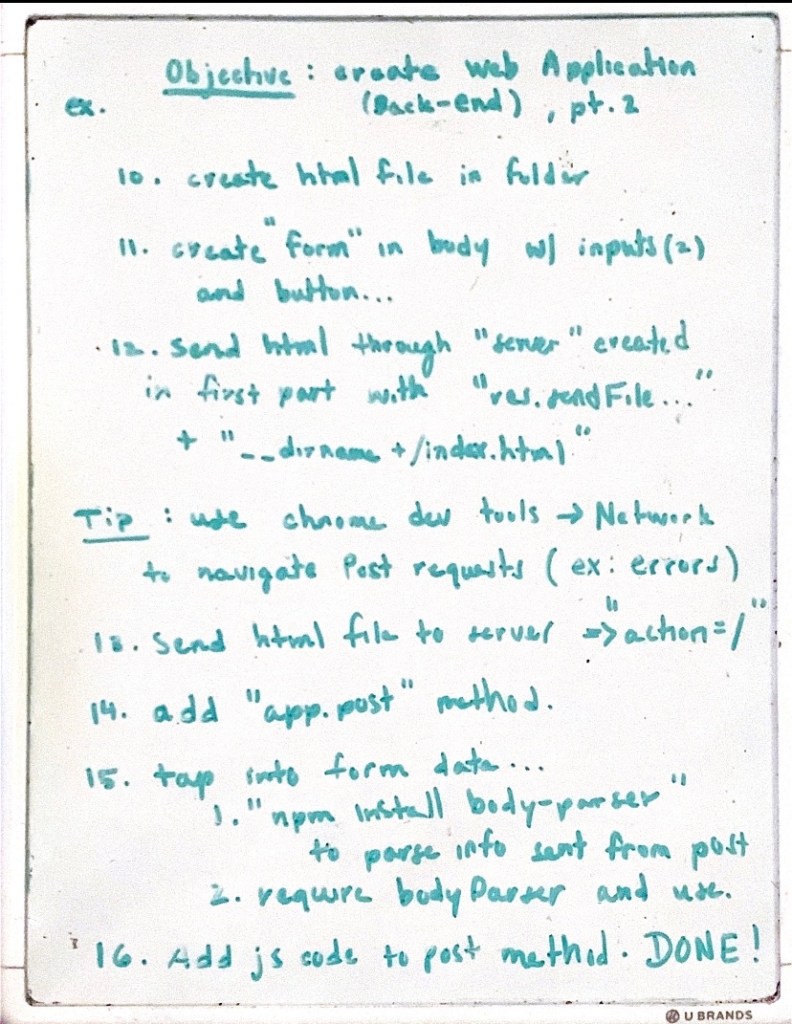
Thanks to App Brewery, I’ve been able to create my first basic calculator through a web server as well instead of having to simply rely on static code to build websites. This calculator project is a huge step up so that I’m able to more fully understand what can be done with code based on the server-side. I’m hoping the project itself holds a lot of conventions so that I am able to adapt to the workflow of creating web-server based code as well. And to help me get a better grasp, I’ve even written the steps out for future reference and a better understanding.
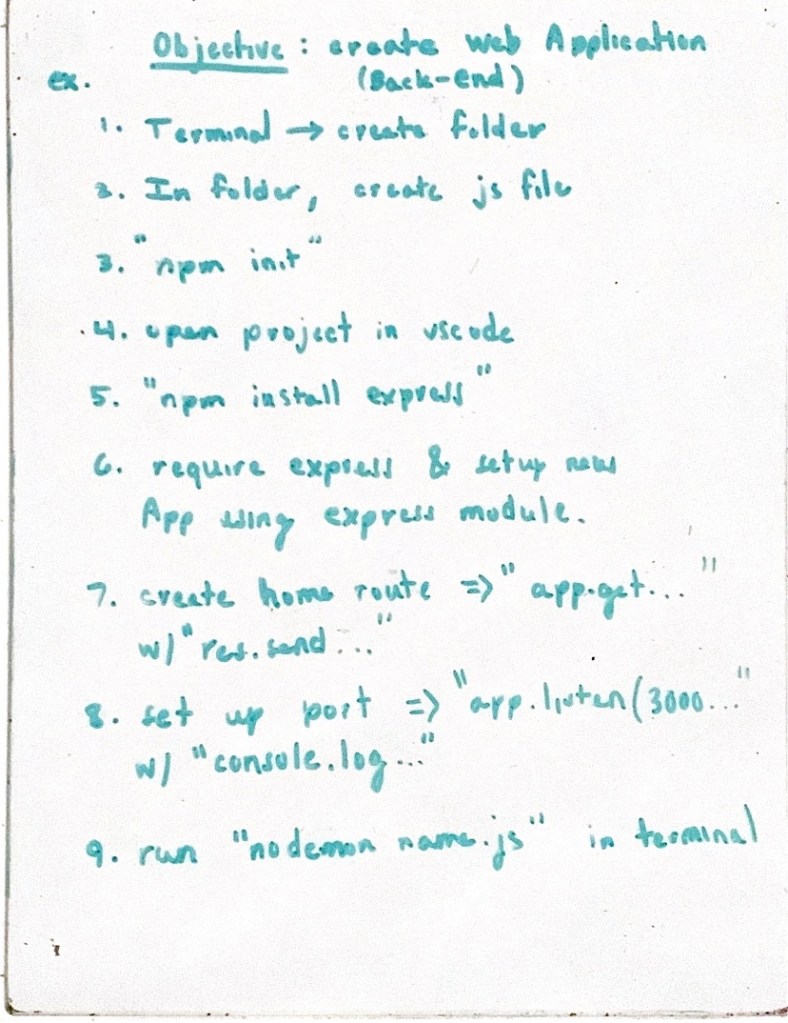
The idea was to also get hands-on experience with the terminal (or in this case a hyper terminal) so I started by creating a new folder there. Once I created the folder, I created a new JavaScript file and then initiated the node package manager (NPM). Once this is done, I moved on to vscode and installed express through the npm. Once Expressed showed up in the package.json file, I “required” it and essentially set up my new application by “adding” express. Finally, I was able to create a home route as well as a port to locate for in the web browser. Once my server is created I run my JavaScript file through Nodemon which I installed globally beforehand so that my server can detect changes made in the future while running.
In the second part of this project, I was able to inject my HTML file so that my server would be able to send this to the web browser. And inside the HTML file, I created a form for the user to use as a calculator. Once this is done, I was able to handle the “post” request using the “res.send” function. Finally, in order to tap into the data provided by the user I simply installed “bodyParser,” required it, and used it so that I was then able to create the actual calculator code in the post method. In order to run this code, I simply went to my web browser and ran “localhost:3000” while the server runs which is the port I used for this project.
To get a better look at my code I’ve included it as a repository on my GitHub which can be accessed via my website.

 Tech Blog